

Adventure Alpha
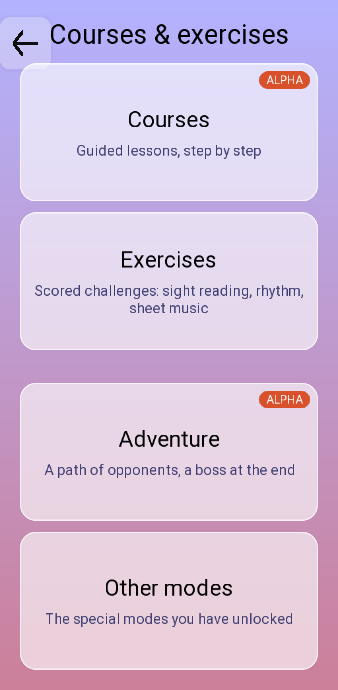
In Adventure you read the same notes as in the exercises, and an opponent reads at the same time. Both of you fill a gauge. The first one to fill it wins the duel. You can play cards along the way to slow the opponent down.
Getting there
The map
 1
2
3
4
5
1
2
3
4
5
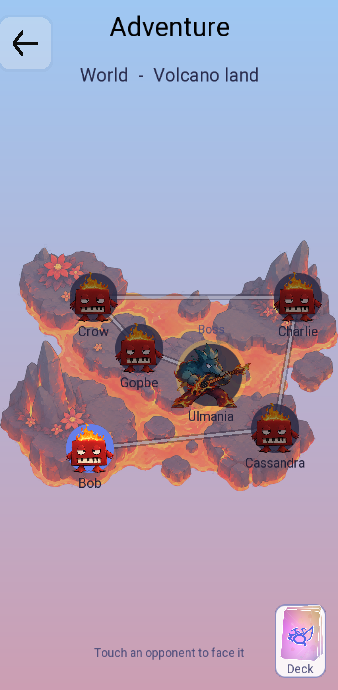
- The name of the world you are on.
- The opponent you can fight. Touch it to start the duel.
- An opponent still closed. Touch it and the app says what is missing.
- The boss.
- Deck — what you carry into the duel is prepared here.
You have to beat an opponent before the next one opens. The path shows the order they come in.
An opponent does not always ask the same thing: notes to read, a rhythm to play, or a full score. A stronger opponent fills its gauge faster.
How a duel runs
 1
2
3
4
5
6
7
8
1
2
3
4
5
6
7
8
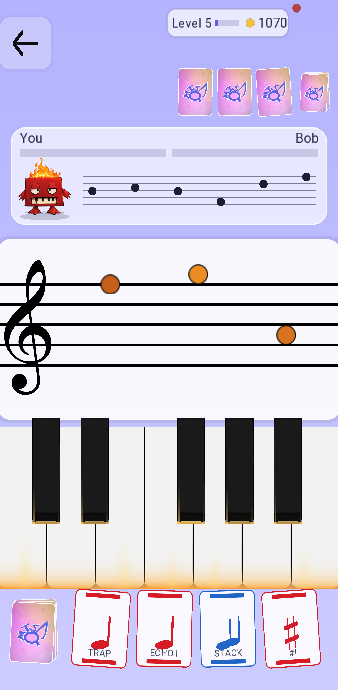
- The cards left to draw.
- Your gauge.
- The opponent’s gauge.
- How far each side still has to go.
- The staff you read.
- The keyboard you answer on.
- The cards in your hand. Touch one to play it.
- Your deck.
- Touch an opponent on the map. A countdown runs, then the duel starts.
- Read and answer on the keyboard, the way you do in the exercise the duel is built on.
- Touch a card in your hand whenever you want to use it.
- The duel ends when one of the gauges is full.
As long as neither gauge is full, the duel will keep going.
Every note you get right pushes your gauge up. Correct notes played in a row are worth more and more. A wrong note does not lower your gauge, and it puts the run back to zero. In sight reading the run has to get going before it pays.
The Streak upgrade bought in the shop does not apply in a duel. Duel scoring is the same for everyone.
The cards
You draw cards during the duel and keep a few in hand. Touch one to play it. Some get in the opponent’s way, others help you along.
Open a card in the deck to see what it does. The ones you meet first work like this:
| Card | What happens |
|---|---|
| STOP! | The opponent is held up until they play a scale. |
| DRAIN | Takes points off the opponent’s gauge. |
| # and b | Drops accidentals onto the notes still to come. |
| ECHO | The duel pauses. You write a bar and the opponent has to play it back. |
| TRAP | Slips a trapped note into the opponent’s page. Playing it costs them points. |
| STACK | Puts a second note on top of one of yours, to be played together. In rhythm it splits a simple figure in two. |
Some cards only work in reading, others only in rhythm. Several of them come in stronger versions of the same effect.
Cards come from lessons you finish and from duels you win. They are not sold in the shop.
The deck
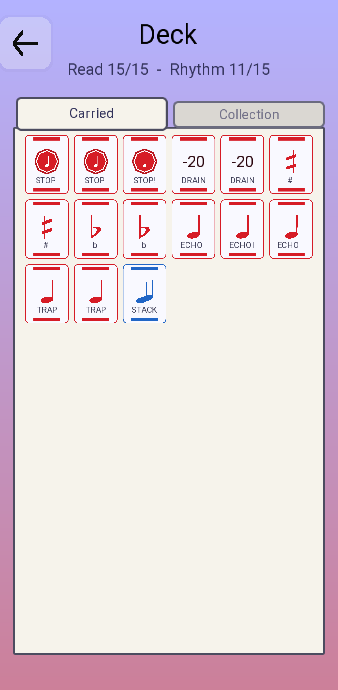
Deck sits in the corner of the map. It opens on Carried, which holds the cards that go into the next duel.
 1
2
3
1
2
3
- The room left, counted apart for reading and for rhythm.
- Carried — the cards you take into the duel.
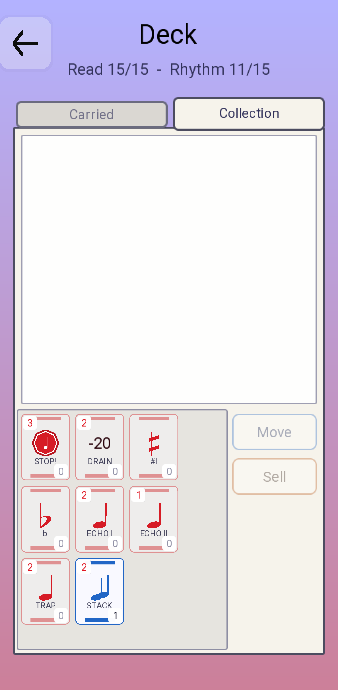
- Collection — everything you own.
Reading and rhythm are counted apart, so a card that only works in reading does not take a rhythm slot. The two counters at the top tell you where you stand on each side.
 1
2
3
1
2
3
- How many of that card you own.
- Move sends the selected card into the deck.
- Sell turns it back into points. They go into the same total as the rest, and you can spend them in the shop.
You can start a duel with an empty deck.
Playing cards from a MIDI piano
With a piano plugged in you have both hands on the keys, and you would have to let go of them to reach the screen. The cards can also be played from the piano. The app listens at both ends of the keyboard, well outside the range the exercises use, so either hand can reach them.
- Plug the piano in and check that the app names your instrument at the bottom of the home screen.
- Draw a card with C♯2 or C♯7.
- Play the cards in hand with the keys that follow.
| Key | What happens |
|---|---|
| C♯2 / C♯7 | Draws a card. |
| C D E F | Plays the first card in hand, then the second, and so on, at octave 2 or octave 7. |
These keys make no sound and they do not change the gauge. Pressing one is not counted as a played note.