
Rhythm
How to count a rhythm you have never seen before
A bar of sixteenths and ties looks like something you have to decode. It is not. There is a single method that works on any rhythm, however it looks, and it takes about ten minutes to understand.
Published 1 September 2026 · 8 min read
Rhythm is the half everyone skips
Ask someone learning to read music what they are working on and they will almost always tell you about notes: clefs, ledger lines, key signatures. Ask them about rhythm and the answer gets vague. This is not laziness. It is a consequence of how the two skills can be practised.
Pitch can be checked silently, anywhere, in your head. Rhythm cannot. A rhythm only exists while it is being performed, against something that keeps time whether you are ready or not. You cannot look at a bar and verify that you understood it — you can only play it and find out.
So rhythm gets postponed, and it shows up later as the thing that stops a piece from working even though every note is right.
The mistake: adding up note values
Here is how most people meet a bar they have not seen before. They look at the first symbol, remember what it is worth, look at the next, remember what that one is worth, and try to assemble the total. A quarter is one beat. An eighth is half. Two sixteenths make one eighth, so four make a beat, unless there is a dot, in which case add half again.
It is correct, and it is hopeless. That is fraction arithmetic, performed under time pressure, while your hands are busy. At 80 beats per minute a bar of 4/4 lasts three seconds. You will not finish the sum.
The deeper problem is that this method treats a bar as a list of durations to be added together. Musicians do not experience rhythm that way. They experience a steady grid that is always running, and notes that land on particular squares of it. Nothing is added up, because nothing was ever taken apart.
The fix: one subdivision, and never let it stop
Pick the smallest note value that appears in the passage. If the bar has sixteenths in it, your grid is sixteenths — for the whole bar, including the parts made of long notes. Then count that grid out loud, at a steady speed, from the first beat to the last, without interruption.
The notes on the page stop being durations to calculate. They become positions to hit. You are no longer asking "how long is this note?" but "which of my syllables does it start on?" — and that is a question you can answer at sight, because you are already saying the syllables.
The one rule that carries the rest. The counting never stops. Not during long notes, not during rests, not during the easy bar before the hard one. The moment the grid pauses, you are back to arithmetic.
The counting syllables
The system is standard, and it is worth using the standard one so that any teacher or method book you meet later agrees with you. Each beat divides into four:
| You are counting in | One beat sounds like | A note starting here |
|---|---|---|
| Quarter notes | 1 — 2 — 3 — 4 | On the beat |
| Eighth notes | 1 and 2 and | On the beat, or exactly halfway between two |
| Sixteenth notes | 1 e and a 2 e and a | On any quarter of a beat |
| Triplets | 1 trip let 2 trip let | On any third of a beat |
Two details matter more than they look. The number is always the beat itself, so 1 and 3 stay in the same place no matter how finely you are subdividing — the grid gets denser, the beats do not move. And triplets get their own row because three does not fit into a subdivision built on halves; you switch grids for the duration of the triplet and switch back.
Reading a bar you have never seen, in four steps
- Find the smallest value in the bar. Not the first note — the smallest one anywhere in it. That sets your grid for the whole bar.
- Say the grid out loud, empty, twice. No notes yet, no instrument. Just 1 e and a, 2 e and a at a speed you can hold comfortably. You are starting the clock before you ask it to do anything.
- Mark where each notehead falls. Go through the bar and say the syllable each note starts on. Not its duration — its starting syllable. Say them aloud: "1, and, 3, a."
- Play it while still counting aloud. The counting is not scaffolding to remove once you have understood; it is the thing that makes the bar come out right. Drop it and the bar drifts.
Notice what step three removed. You never worked out that the note was three sixteenths long. You worked out where it starts, and the next note tells you where it ends. Duration takes care of itself once positions are right.
Where it gets hard, and why
Four things trip people up, and all four are the same mistake in different clothes: the grid stopped.
- Rests are counted, not skipped. A rest is a position you pass through in silence, exactly like a note you hold. Beginners go quiet during rests — including in their counting — and come back early.
- Dots add half of what came before. A dotted quarter is a quarter plus an eighth. Do not compute that: count it. It occupies 1, and, 2 and the next note starts on and. The dot is a positioning instruction, not a sum.
- Ties cross the barline and nothing else changes. A tie means "do not re-attack" — keep counting straight through it. The grid does not know a barline happened.
- Syncopation is a note that avoids the beat. It only feels strange if you are counting beats. If you are counting the subdivision, an off-beat note is on an ordinary square of your grid — it lands on and, or on a, and there is nothing special about it.
That last one is the payoff. Players who count only beats find syncopation genuinely hard, because the note falls in a place their counting does not name. Players who subdivide have a name for every position, so there is no such place.
Why you cannot learn this in your head
Everything above can be understood in one sitting. None of it can be acquired in one sitting, and the reason is worth being blunt about.
Timing is a motor skill measured in milliseconds. Playing a sixteenth thirty milliseconds late is audibly wrong and completely invisible to the person who did it — your own ear grades you generously, because it hears what you intended. Practising alone, you drift, you compensate, and you build the drift into the habit.
So rhythm practice needs two things that reading practice does not: an external clock that does not slow down when you do, and immediate feedback on each stroke — not at the end of the bar, when you have already forgotten what your hand did.
A metronome gives you the first and none of the second. A teacher gives you both, once a week. The gap in between is where an app is genuinely useful, and it is the gap our own was built to fill.
What that looks like in practice
MT Sound Quest is our free Android app, and its rhythm module is the method above turned into something you can do for ten minutes with a phone on a table.
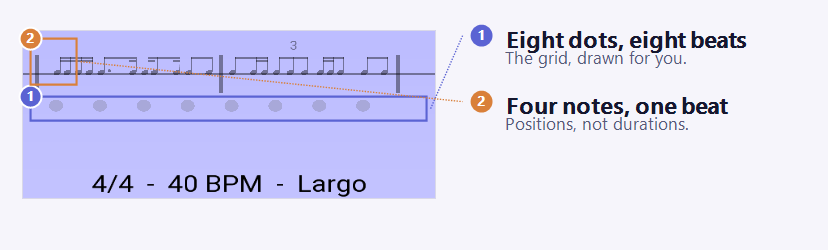
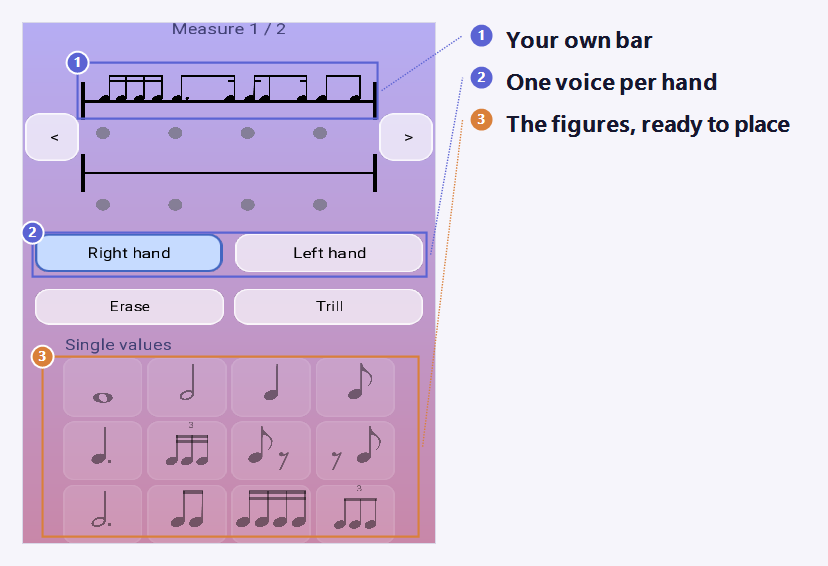
That is the app in the video at the top of this page. The score moves under a steady pulse and each stroke is marked where it actually fell — green on the beat, red beside it. The screen is deliberately close to what this article describes: the rhythm sits on a single line, because pitch is not the question here; beneath it runs a row of dots, which is the subdivision drawn rather than imagined; and there are two drums instead of one, so a passage can be split between your hands the way it would be on a real instrument.
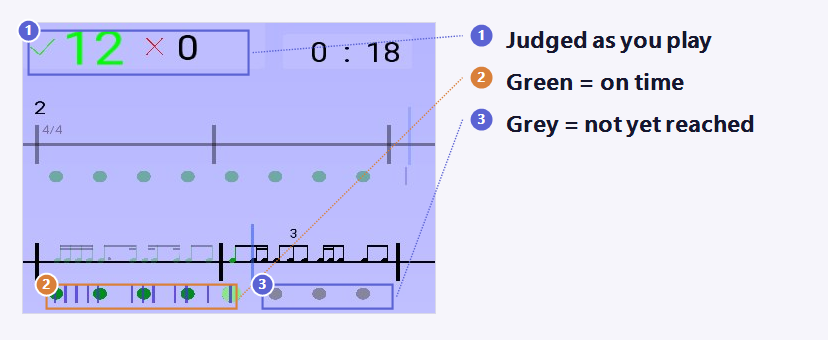
Three things about it map directly onto the problems above:
- The clock is not yours. The beat runs at the tempo you set and does not wait. Start at 40 BPM — genuinely slow — and raise it only once a figure is clean. Slow and correct builds the reflex; fast and approximate builds a habit of approximation.
- The verdict arrives on the stroke. Each hit is marked at the position where it landed, while you still remember what your hand did. That is the feedback loop a metronome cannot give you.
- You can practise the one figure that is failing. The app keeps accuracy figure by figure — sixteenths, triplets, syncopation — so you can see which one is dragging instead of guessing. And with the rhythm maker you can write the two bars you keep stumbling on, bar by bar, and send them straight to the trainer.
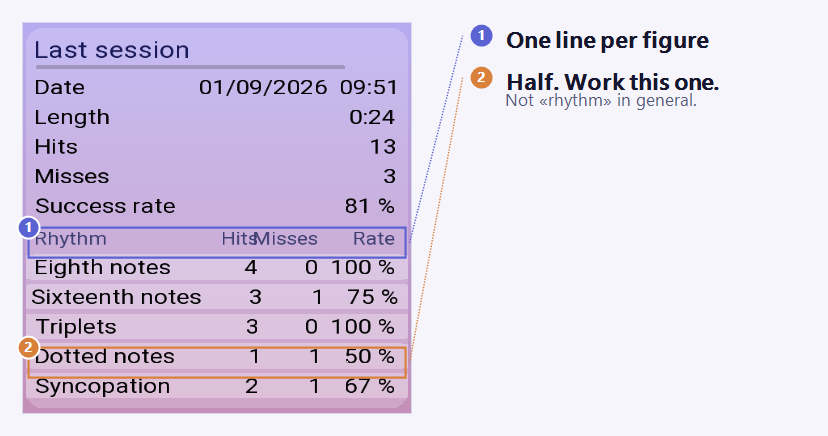
It is free, it works offline, and there is no account: your rhythms and statistics stay on the phone. It is one option among several — a teacher is better, and a metronome plus real discipline will also get you there. What it does is make the daily ten minutes cheap enough that you actually do them.
Working on the other half too? Our free note reading exercise runs in the browser with nothing to install, and the companion article on reading the bass clef covers pitch the way this one covers timing.
How to practise so it sticks
- Ten minutes, every day. Timing is a reaction, and reactions decay between sessions. Short and daily beats an hour on Sunday, by a wide margin.
- Count out loud, even when it feels silly. Counting silently is the first thing to lapse under pressure, and you will not notice it lapsing. Out loud, you hear it stop.
- Slow enough to be perfect. If you are missing, the tempo is too high. A figure played correctly twenty times at 50 BPM is worth more than the same figure played approximately at 100.
- One figure at a time, at several tempos. Do not practise "rhythm" — a vague target gives you no way of knowing whether you improved. Take a single figure, sixteenths say, and drill it on its own: slow until it is clean, then faster, then slow again. Changing the tempo is not about speed. A figure you can only play at one speed is a memory of that speed; one that survives being moved is a skill.
- Then combine it with figures you already own. Put the new figure next to two or three you have already mastered, and practise the joins — that is where it will break. A bar that is clean in isolation still falls apart when it has to follow something else, because the difficulty was never the figure itself but the transition into it. This is exactly what the rhythm maker is for: write two bars of what you own, drop the new figure in, send it to the trainer. Isolate, vary the tempo, combine — then take the next figure.
How long it takes
The method is an evening's work. The reflex takes a few weeks, and it announces itself in a particular way: you will play a bar of sixteenths correctly and realise afterwards that you were not counting it deliberately — the grid was simply running underneath.
That is the same milestone as reading a note without naming it first, and it arrives the same way. Not through talent, and not through long sessions. Through daily minutes against a clock that does not forgive you.
Frequently asked questions
How do you count 1 e and a?
Each beat divides into four equal syllables: 1 e and a, 2 e and a, and so on. The number is the beat, and is the halfway point, and e and a are the quarter points. Say all four at a steady speed whatever the music does, and play a note whenever one of your syllables lines up with a notehead.
What is the fastest way to learn rhythm?
One figure at a time, against an external clock, at a tempo slow enough that you never miss — with immediate feedback on each stroke. Take each figure through a range of tempos before moving on, then combine it with figures you already own and practise the joins: a bar that is clean on its own still breaks when it has to follow something else. Slow and correct builds the reflex; fast and approximate builds a habit of approximation. Ten focused minutes a day beats an hour once a week.
Should I learn rhythm or note reading first?
Both, from the start — they are the two halves of the same skill. One answers which note, the other answers when, and a score asks you both questions at once. They also feed each other: a steady subdivision gives your reading a pulse to sit on, and reading that has become automatic frees the attention that timing needs.
Train them in separate sessions, though — the browser exercise for pitch, the rhythm trainer for timing — so that a weakness in one cannot hide behind the other. Then alternate them day to day, and combine them on real music once each one holds on its own.
Why do I speed up when I play?
Almost always because the counting stopped during the easy bars. Without a subdivision underneath, the tempo drifts with your confidence. The fix is not to concentrate harder but to keep the grid running out loud through the easy passages, so it is still there when the hard bar arrives.