
Sight reading
How to read bass clef notes without counting up from middle C
If reading the bass clef feels slower than the treble, it is almost never because you know less. It is because you are doing arithmetic. Here is what to replace it with.
Published 28 August 2026 · 7 min read
Counting is the habit that keeps you slow
Nearly every beginner reads the bass clef the same way: find middle C, then walk down the staff one line at a time until you reach the note on the page. It works. That is exactly the problem — it works well enough that you never stop doing it.
Counting is arithmetic, and arithmetic takes time you do not have. At a modest 80 beats per minute, a quarter note lasts three quarters of a second. Walking down four lines to identify one note takes longer than that, so the music leaves without you. Worse, the more you count, the better you get at counting — and counting is a skill you are trying to lose.
Fluent readers do something different. They do not identify notes one by one. They recognise a handful of positions instantly, and read everything else as a distance from those positions. Those positions are called anchors, and you only need four.
Anchor one: the clef is telling you a note
The bass clef has a second name that almost nobody uses, and it gives the whole game away: it is the F clef. Look at the two dots. They sit above and below the fourth line of the staff, and they are there to point at it. That line is F.
This is not a memory trick, it is what the symbol is for. The shape evolved from a handwritten letter F, and the dots survived as the pointer. The treble clef does the same thing: its spiral curls around the second line, and that line is G, which is why it is properly called the G clef.
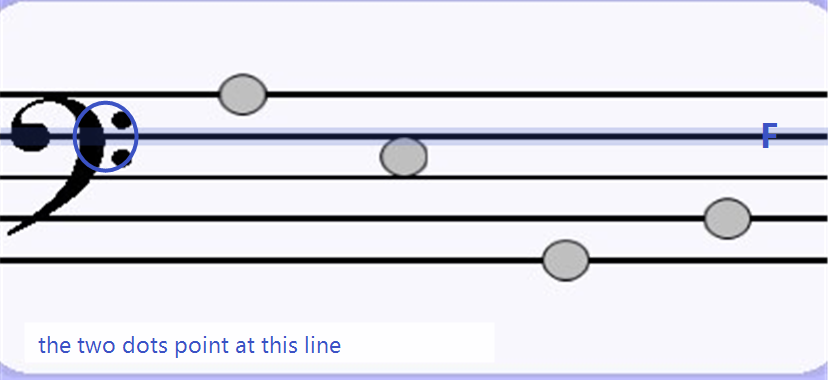
So your first anchor costs nothing to learn. Every time you see the bass clef, you are already being told where F is. Read the dots as a label rather than as decoration and you have a fixed point on the page.
Anchors two, three and four
Three more positions turn the staff into something you can navigate without counting:
- Bottom line: G. The lowest line of the staff. It is the floor — a note sitting on it is at the bottom of your visual field, which makes it easy to spot without analysis.
- Middle line: D. The centre of the staff, visually the easiest position on the page. Anything above it is high, anything below it is low.
- Top line: A. The ceiling, and the mirror of the bottom line.
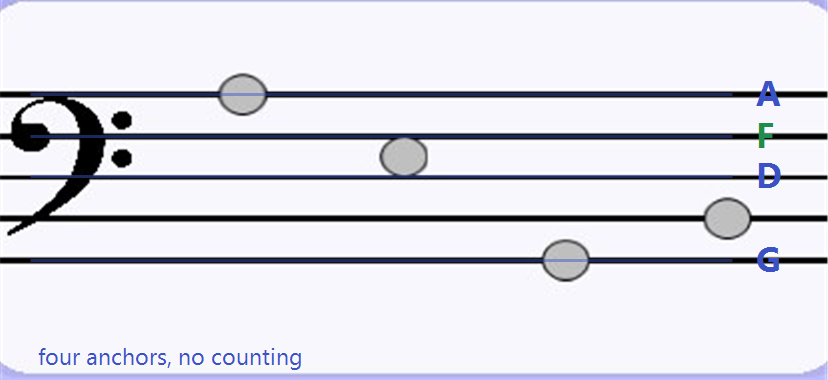
With G at the floor, D in the middle, F on the clef's line and A at the ceiling, no note on the staff is more than one step away from an anchor. You stop counting from middle C because you no longer need a starting point that far away — you are always near one.
The mnemonics, and where they stop helping
You have probably met them. The lines of the bass clef, bottom to top, are G, B, D, F, A — Good Boys Do Fine Always. The spaces are A, C, E, G — All Cows Eat Grass.
They are worth knowing, and they are a trap. A mnemonic is a sentence you recite from the beginning: to find the fourth line you say the whole phrase and count words. That is the same arithmetic in a friendlier costume, and it caps your speed at the rate you can recite.
Use them to check yourself when an anchor fails, never as your main route. The goal is for the position on the page to trigger the note name with nothing in between — no sentence, no counting, no middle C.
Ledger lines and the middle C problem
Middle C is the note that connects the two staves: it sits on the first ledger line above the bass clef and the first ledger line below the treble clef. Same pitch, same key on the piano, two different places on the page.
This is where many pianists lose time, because they treat middle C as the origin of both staves and navigate outward from it. Anchoring each staff separately removes the problem. Middle C then becomes just another recognised position rather than the hub everything routes through.
For ledger lines below the staff, keep using the floor: one ledger line below the bottom line is E, two is C. You are counting two steps from an anchor, not eight from another clef.
How to practise so it actually sticks
Recognition is a reflex, and reflexes are built by repetition under mild time pressure — not by reading about them. Three rules make the difference:
- Ten minutes, every day. Short and daily beats an hour on Sunday. You are building a reaction, and reactions decay between sessions.
- Random notes, not pieces. A piece lets you predict what comes next from the melody, which hides whether you can actually read. Random notes remove the guessing.
- Answer, then check immediately. A delayed correction teaches nothing. The feedback has to arrive while you still remember what you were thinking.
Practise it now, in your browser. Our free note reading exercise shows one note at a time on the bass clef and you name it on a keyboard — no sign-up, nothing to install. Switch to the treble clef, or turn both on to alternate between them, which is the fastest way to stop translating one into the other.
How long it takes
Faster than most people expect. The knowledge itself takes an afternoon — four anchors and two mnemonics. What takes time is the reaction, and with ten focused minutes a day most beginners stop counting within two to four weeks.
You will notice the change in a specific way: you will realise you played a line correctly without remembering having identified the notes. That is the point at which reading stops competing with playing for your attention.
After that comes the stage worth aiming for. Anchors are scaffolding, and scaffolding is meant to come down. Keep the habit daily — the exercise above, or MT Sound Quest on your phone, which is built around exactly this ten-minute loop — and somewhere inside three months the fourth line stops being the line the dots point at. It is simply F. No anchor, no mnemonic, no gap at all between seeing and knowing. That is what reading fluently means, and it is a matter of daily minutes rather than of talent.
Then add the other half: rhythm
Naming notes is only one of the two questions a score asks. The other is when. Most players who have solved pitch still stumble on rhythm, because rhythm cannot be practised by looking — it has to be performed against a beat, and judged on both the moment the note starts and how long it is held.
That is what our Android app adds to the exercise above: MT Sound Quest trains sight reading and rhythm side by side, and it works with a real digital piano over a USB MIDI cable so your own keys become your answers. It is free.
Frequently asked questions
Why is the bass clef called the F clef?
Its two dots sit above and below the fourth line, and that line is F. The clef points at a note and names it. Read the dots as a label and you have your first anchor.
What are the bass clef notes from bottom to top?
The lines are G, B, D, F and A. The spaces are A, C, E and G. Middle C sits on the first ledger line above the staff.
How long does it take to read bass clef fluently?
With ten focused minutes a day, most beginners stop counting within two to four weeks. Keep the habit up — with the exercise above or with MT Sound Quest — and the anchors themselves fade: inside three months the fourth line is simply F, recognised on sight. What improves is reaction time, and reaction time only responds to daily repetition.
Should I learn treble clef before bass clef?
No. Learning them in sequence builds the habit of translating between them, which is the habit that slows pianists down. Alternate from the start so each staff gets its own anchors.